
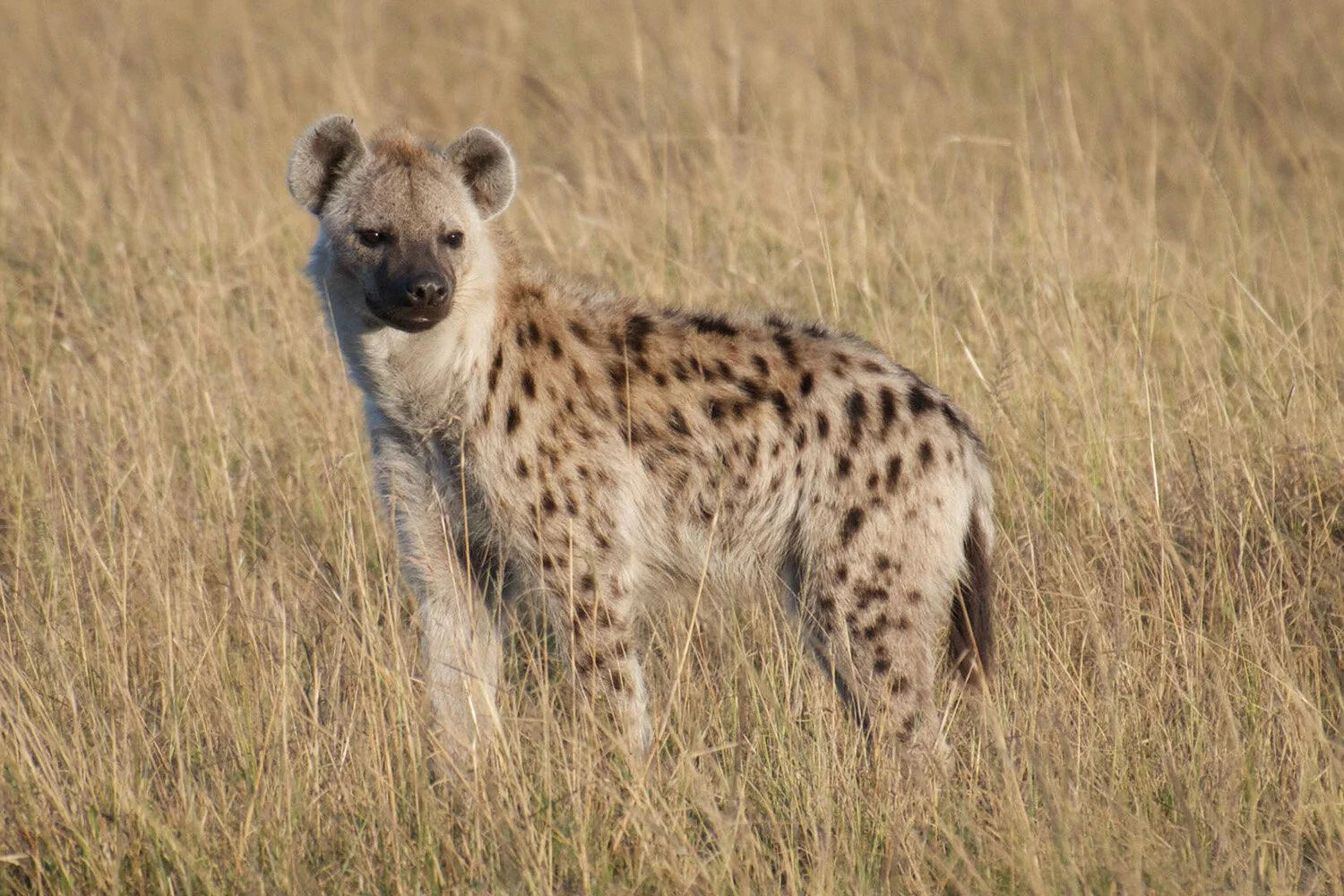
This is the first misunderstanding. The sound that humans translate as mockery or madness is neither joke nor taunt; it is breath forced through a narrow passage of muscle and bone, a social signal sharpened by hunger, submission, and fear. In the wild, the hyena’s “laugh” is an admission, a negotiation, a white flag shaped like a grin. To survive, it must sound ridiculous. To live another night, it must smile.
And so the hyena hangs—figuratively and sometimes literally—between caricature and catastrophe.
For centuries, the hyena has been suspended in human imagination like a criminal at the gallows. Hated. Feared. Misread. It occupies a strange middle rung on the ladder of life: not noble like the lion, not clever enough (in our stories) like the fox, not loyal like the dog. The hyena is the scavenger, the thief, the laugh-track villain skulking at the edge of the savanna, waiting for others to finish before it dares to eat.
But survival, especially survival at the margins, requires sharper tools than dignity.
The Anatomy of a Smile
Look closely at a hyena’s face. Not in the quick, dismissive way cartoons train us to, but in the patient way one studies a map before crossing hostile territory. The mouth stretches wide, corners pulled back as if permanently caught between grin and snarl. Teeth dominate the expression—conical, bone-crushing instruments designed not for elegance but for finality. A hyena does not nibble. It ends things.
This smile is not friendliness. It is exposure.
In the animal world, showing teeth is usually a threat. For hyenas, it is also a liability. Their social structure forces constant communication: Who is dominant? Who yields? Who eats first? Who waits and risks starvation? The grin becomes a language, and like any language, it can be misunderstood by outsiders who only hear noise and see shapes without context.
Humans saw that grin and filled in the rest with fear.
In medieval Europe, hyenas were believed to be hermaphrodites, grave robbers, shape-shifters that lured victims by mimicking human voices. In parts of Africa and the Middle East, they were associated with witchcraft, curses, and possession. The hyena did not just kill; it corrupted. It did not just eat the dead; it violated them. It was the animal that refused to respect boundaries humans believed sacred.
But the truth is simpler and far more brutal: the hyena eats what others leave behind because it must. It survives because it cannot afford sentimentality.
Hanging Between Worlds
The phrase “hanging hyena” evokes an image of punishment—an animal strung up as an example, a warning, a sacrifice. And while hyenas are not commonly hanged in practice, they are hanged in perception. Suspended between predator and scavenger, strength and ridicule, intelligence and superstition, they exist in a limbo that makes them easy to despise.
They are not the fastest hunters, though they are capable ones. They are not the most beautiful animals, though their forms are perfectly adapted. Their bodies slope downward from powerful shoulders to narrower hips, giving them a hunched appearance that reads as deformity to the human eye. Their gait is awkward. Their vocalizations are unsettling. They do not fit the aesthetic we have assigned to power.
And in nature, as in culture, those who do not fit the image are punished.
The hyena’s social hierarchy is ruthless. Females dominate males. Cubs fight siblings from birth. Rank determines access to food, safety, and mating rights. To be low-ranking is to be perpetually hungry, perpetually threatened. Submission is not a choice; it is a survival strategy. That strange laughter? Often it is the sound of a lower-ranking hyena acknowledging its place, appeasing those who could kill it without consequence.
Imagine laughing every time you are afraid. Imagine smiling to signal that you are not a threat, even as your ribs ache with hunger. Imagine your expression being the very thing that convinces the world you are cruel, stupid, or insane.
The hyena does not hang because it is weak. It hangs because the system demands it.
Scavenger as Mirror
What humans hate about hyenas says less about the animal and more about ourselves.
We despise scavengers because they remind us that death is inefficient. That nothing is wasted. That bodies become resources. That the line between life and rot is thinner than we like to believe. The hyena does not kill every meal, and that offends our moral hierarchy of predators. We prefer violence with a narrative arc: chase, struggle, victory. The hyena interrupts that story. It arrives after the climax, eats the remains, and leaves nothing but dust and cracked bone.
In doing so, it exposes the lie that nobility exists in nature.
Nature is not noble. It is effective.
Hyenas can digest bone. Their stomach acid is so powerful it dissolves calcium like sugar in tea. What lions abandon—hooves, skulls, spines—hyenas finish. They clean the land not out of kindness, but necessity. Disease spreads where carcasses linger. Hyenas reduce that risk. Ecosystems rely on them in ways that are invisible until they are gone.
Yet invisibility is the hyena’s curse. When it works, no one notices. When it laughs, everyone recoils.
This is the paradox of survival at the edges: your value increases as your reputation worsens.
The Politics of Teeth
In popular culture, hyenas are rarely allowed complexity. They are henchmen, lackeys, chaotic extras to a lion’s heroism. They laugh because they are foolish. They fail because they deserve to. Even when they are numerous, they are portrayed as disorganized, greedy, treacherous—never disciplined, never admirable.
But reality is inconvenient.
Hyena clans can number up to eighty individuals. They coordinate hunts. They defend territory. They remember faces, relationships, slights. Studies suggest hyenas have problem-solving abilities comparable to primates. They recognize social rank not only within their own species but among others. They are strategic, patient, and brutally pragmatic.
If lions are kings, hyenas are politicians.
And like politicians, they are despised not because they are ineffective, but because they operate in the gray spaces where morality blurs into compromise.
The hyena smile, then, becomes a political tool. It signals allegiance, submission, or challenge depending on context. It is not a mask; it is a weapon. A hyena without its grin is a hyena without language.
To take that away—to reduce it to mockery—is to silence the very thing that keeps it alive.
Hanging by Human Hands
Beyond metaphor, hyenas suffer materially because of their reputation. They are poisoned, trapped, shot, and chased from land increasingly dominated by human expansion. Farmers blame them for livestock losses, often inaccurately. Hyenas become scapegoats for economic stress, environmental change, and fear of the wild encroaching on controlled spaces.
They are punished for adaptability.
When ecosystems fracture under climate pressure, hyenas persist. They move closer to human settlements. They eat refuse. They survive where more specialized predators fail. This proximity breeds resentment. The hyena becomes a symbol of disorder, a reminder that human boundaries are porous.
And so they are killed not just for what they do, but for what they represent: the refusal to disappear quietly.
In this sense, the hanging hyena is not just an animal. It is an archetype.
The Smile as Resistance
There is something quietly defiant about an animal that survives ridicule. The hyena does not correct the record. It does not attempt to look noble. It does not soften its laughter or straighten its back. It lives anyway.
Its smile is sharp because it has to be.
In a world where dominance is enforced through violence, signaling submission can be more powerful than open challenge. In a system stacked against you, flexibility outperforms pride. The hyena understands this intuitively. It yields when it must. It presses when it can. It laughs through pain because silence would invite death.
This is not weakness. It is strategy refined by generations of near-erasure.
There is an uncomfortable lesson here for humans, especially those who find themselves misread, marginalized, or mocked for traits that are, in fact, adaptive. Laughter can be armor. Smiles can be shields. Survival sometimes requires playing the role assigned to you until the danger passes.
But there is a cost.
To be constantly perceived as ridiculous is to be constantly underestimated. And while underestimation can be useful, it also justifies cruelty. The hyena is beaten not because it is dangerous, but because it is assumed not to matter.
Rewriting the Noose
What would it mean to unhang the hyena—to release it from the gallows of myth?
It would require acknowledging that survival does not need to look heroic. That intelligence does not always wear symmetry. That laughter can coexist with violence without canceling either out. It would require us to admit that ecosystems depend not just on apex predators, but on the creatures willing to clean up what remains.
More uncomfortably, it would require us to examine why we are so eager to vilify what makes us uneasy.
The hyena reminds us that life feeds on death. That order emerges from mess. That beauty is not a prerequisite for value. In laughing, it reveals the absurdity of our expectations. In enduring, it exposes the fragility of our judgments.
The hyena does not ask to be loved. It asks to be left alone to do what it has always done: survive with whatever tools it has been given, even if those tools look like a grin carved from bone.
Conclusion
At night on the savanna, the hyena’s laughter carries far. It echoes off hills, slips through grass, unsettles the air. To human ears, it sounds like madness. To other hyenas, it is information. To the ecosystem, it is continuity.
The hanging hyena is only hanging in our stories.
In reality, it walks. It hunts. It waits. It eats. It raises young in a world that does not forgive mistakes. Its smile remains sharp not because it enjoys cruelty, but because survival demands edges.
Perhaps the truest cruelty is not the hyena’s laughter, but our insistence on mistaking it for something lesser.
And perhaps the sharpest survival skill of all is continuing to smile when the world has already tied the rope.
 aaronaddams